















The Interstate 5 bridge over the Columbia River is considered “obsolete” by the Federal Highway Administration because its lanes aren’t wide enough, there are no shoulders and its design fails to meet the burgeoning traffic demand. (Grant Stringer/States Newsroom)
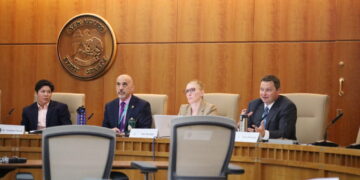
A group of Washington and Oregon lawmakers gathered Monday, expecting to hear a new estimate of the cost to replace the Interstate 5 bridge across the Columbia River.
When it didn’t come, some on the bi-state and bipartisan committee assigned to keep tabs on the megaproject rebuked planners responsible for delivering the updated figures. Lawmakers are wrestling with budget challenges in both states, they said, and escalating costs might need addressing in their respective 2026 sessions.
“I want a date, and I want a report, or else I would say that your team is not doing its work,” said Oregon state Rep. Thủy Trần, D-Portland. “You can’t punt it down the road without giving us something.”
Washington state Rep. John Ley, R-Vancouver, said he was “extremely disappointed” because if costs are rising, the two states may be asked to give additional money. Lawmakers need time to explore ways to trim the project to something “closer to our taxpayers ability to pay,” he said.
Project planners acknowledged they didn’t deliver. They said they are waiting to learn if the U.S. Coast Guard will allow the design of the new bridge to be the fixed span desired by the two states or require a movable span like the existing bridge.
A movable span will add more than a half-billion dollars to the project’s price tag.
That decision is critical to an “accurate and comprehensive cost estimate,” said Carley Francis, southwest regional administrator for the Washington State Department of Transportation and the incoming interim director of the Interstate Bridge Replacement Program.
Project planners had estimated the price tag for replacing the bridge would range from $5 billion to $7.5 billion, with a likely figure of around $6 billion. Construction costs have soared by 30% or more on transportation projects in the Seattle and Portland regions in recent years.
There’s no sign the trend will reverse. It’s why lawmakers in September said they anticipated the next cost estimate will exceed $8 billion and could reach $10 billion.
While Francis detailed the process for calculating an estimate, she veered away from positing any numbers Monday. She made clear multiple times it won’t be done until they know what kind of bridge it will be.
“I do not have a specific time frame for you today because the Coast Guard decision is so material,” she said.
‘Tremendously tough project’
2026 is shaping as a year of critical decisions for the project.
First up, is the U.S. Coast Guard’s determination.
Three years ago, the federal entity embraced a movable span but gave the two states time to put forth an argument for a fixed span. Last month, project planners submitted a report responding to the Coast Guard’s arguments that included agreements to offset impacts to those businesses that cannot travel under a fixed span.
Also early next year, the Federal Highway Administration and Federal Transit Administration are expected to publish the final supplemental environmental impact statement for the project. But it cannot be finished until the bridge configuration is known.
Once the bridge design is set, staff said they can update the cost estimate and complete a separate plan showing how the multi-year undertaking will be financed.
That financial plan is due to the federal government by the end of next September and is needed to unlock a $1.5 billion capital investment grant secured last year. Missing the deadline puts those dollars at risk, although program staff said they’d seek an extension if they are waiting on a bridge design decision and environmental report.
If required approvals are in hand in 2026, as planners anticipate, cars could begin driving across a new bridge in 2032 or 2033.
It’s a “tremendously tough project,” said outgoing program administrator Greg Johnson.
“The biggest hedge we have against escalation and inflation is getting started, getting shovels in the ground,” he added.
Questions abound
Lawmakers weren’t alone in their pique at the lack of new projected price tag.
“Tragically today you have failed to get the most important information about this project: How much it will cost,” said Joe Cortright, director of City Observatory in Portland, a think tank focusing on urban economic issues. “They really know the cost estimate will be much higher but they are not sharing it with you.”
Chris Smith of Just Crossing Alliance, which advocates for light rail and transit on the future bridge, said the delay in producing numbers is part of a “nakedly political process to avoid delivering bad news.”
Laurie Layne of Buckley, a small town in Washington’s Pierce County, urged lawmakers to remember that many residents of the two states cannot afford to pay more.
“A lot of us taxpayers are on hamburger helper budgets,” she said.
Cost estimate and bridge design were not the only outstanding matters flagged Monday.
Oregon Rep. Shelly Boshart Davis, R-Albany, said it’s problematic that administrators know how bicyclists and pedestrians will be served but haven’t decided on how many auxiliary lanes there will be on the bridge, calling it a top concern for the freight industry.
Johnson said a decision on whether the bridge will include one or two auxiliary lanes in each direction will be made next year in the final supplemental environmental impact statement.
Oregon Capital Chronicle reporter Mia Maldonado contributed to this report
YOU MAKE OUR WORK POSSIBLE.
This post was originally authored and published by Jerry Cornfield from Washington State Standard via RSS Feed. Join today to get your news feed on Nationwide Report®.